
IMPLANT DENTISTRY
DENTAL CROWNS
DENTAL BRIDGES
Root Canal
SMILE AESTHETICS
Dental Veneers


How can you add a layer that improves the functionality and placement of dentures?
Dentures are artificial teeth that replace natural teeth lost due to decay, gum disease, or injury. They serve as replacements for your original items, providing the same functionality and aesthetic.
While dentures restore teeth’s purpose and appearance for many patients, they don’t always stay perfectly stable over time. This is mainly because they are not properly maintained. Common complaints include looseness, discomfort, and difficulty chewing, especially as the fit changes with normal bone and gum changes.
Denture adhesives can help in these situations by creating a stronger seal between the denture and gums, improving comfort for daily use.
We’ll explore multiple vectors in dentures, and how to identify when you should use dental adhesives.
Denture Adhesives are products designed to improve the stability of removable dentures. They work by creating a thin, sticky layer between the denture base and your gums. This, in turn, fills small gaps and forms a seal that reduces movement.
Adhesives are available in many forms, including creams, powders, and pads, but they all serve the same function. That function is dentures fitting securely and comfortably.

While dentures may not require immediate professional evaluation, over time they will need maintenance. Dentures are like teeth; they need consistent maintenance and care.
The care needed for dentures includes using denture adhesives, which provide stability and limit future mobility. These adhesives are an aid to the longevity of your dentures, not a fix. If you suddenly feel you need to use more adhesive, you must visit your dentist immediately.
In a recent article, the Food and Drug Administration in the US explicitly highlighted, Do not use more adhesive than recommended. This further underscores that adhesives are a maintenance step, not a fixing step.
Not sure which option is right for you? Book a free, no-obligation consultation with our dental team and get a personalised plan and honest price breakdown.

Denture adhesives are essential for maintaining your smile and denture functionality, serving as a protective barrier that enhances and extends their lifespan.
We’ll explore the different types of adhesives, outlining their advantages and disadvantages, and how to use them step by step.
Creams are one of the most popular choices in adhesives, due to its ease of use and good results.

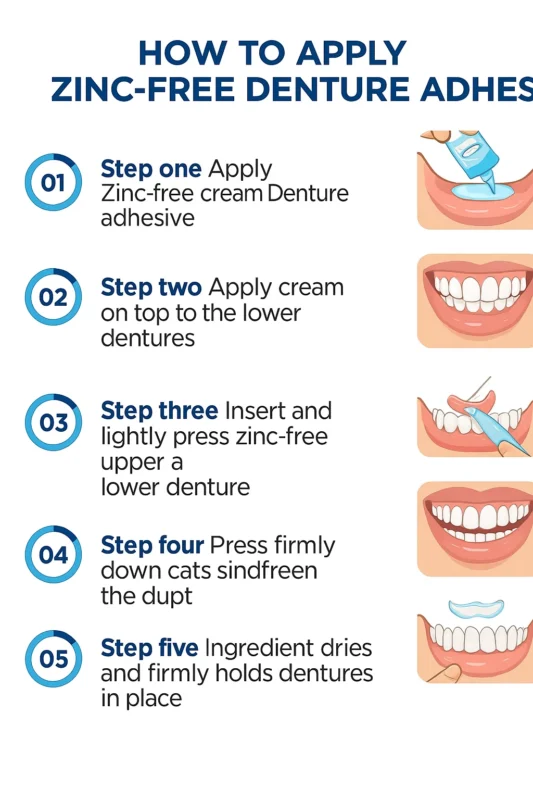
How to Use (step-by-step) for cream adhesives, from cleaning and drying your dentures to applying a zinc-free, pea-sized amount and biting firmly.
Creams are just one type of product, lets find out more about powders and how you can apply them.
Powdered adhesives are unlike creams; they require you to dampen the denture so it can become sticky.
Powdered adhesives are sprinkled onto a dampened denture, then pressed firmly in place, a lightweight option that suits partial dentures well.
These are pre-cut sheets designed for quick and clean application. They are less messier compared to creams or powder. They provide a measured amount of adhesive, which makes them a suitable option for patients that want ease of use.

Thermoplastic denture adhesives are heat-softened materials that mold to the shape of the denture base.
They offer a customised fit and stronger grip, and are used in special cases where normal adhesives are less effective.
Choosing the right adhesive is vital, but identifying its risks and which is safer is as important.
Adhesives are a maintenance aid, not a fix. If you keep reaching for more adhesive, the fit itself may need attention. Dr. Cem Baysal’s clinic in Turkey can assess your dentures and recommend the right long-term solution for a secure, comfortable smile.
Fill in the form below, we’ll get back to you within 24 hours.
Multiple healthcare providers have highlighted the risk of using adhesives that contain high concentrations of zinc. There are also risks of potential toxicity due to chronic overuse, which can lead to neurological issues such as; numbness, tingling, loss of balance, and paralysis.
Some denture adhesives may cause localized allergic reactions or irritation. Reactions are uncommon but can occur due to flavoring agents (e.g., peppermint oil, menthol), preservatives, or colorants. Symptoms may include redness, burning, or soreness of the oral mucosa.
Some denture adhesives may cause localised allergic reactions or irritation. Reactions are uncommon but can occur due to flavouring agents (e.g., peppermint oil, menthol), preservatives, or colourants. Symptoms may include redness, burning, or soreness of the oral mucosa.

These potential risks have also led some patients to explore natural alternatives, though their effectiveness remains less proven.
Thermoplastic adhesives generally give the strongest, longest-lasting grip because they are heat-softened and mould to the denture base for a semi-custom fit, which helps patients with resorbed ridges or irregular gum shapes. Creams also provide a strong hold and are more versatile and widely available. Thermoplastics cost more, need heating before use and can feel bulky if applied incorrectly.
The safest choice is a zinc-free product used strictly in the amount stated on the label. High zinc concentrations and chronic overuse carry a risk of toxicity and neurological problems such as numbness, tingling, loss of balance and paralysis. The FDA states clearly that you should not use more adhesive than recommended. Flavourings, preservatives or colourants can also cause redness, burning or soreness.
If adhesive oozes out along the sides of the dentures after you bite down, you have used too much. Remove the dentures, wash them thoroughly with running water and cleanser, dry them and repeat the steps with the smaller amount stated on the label, usually pea-sized drops on the upper and lower denture. Needing steadily more adhesive is a warning sign.
Take out your dentures, wash and dry them, then sprinkle powder onto the upper denture and dampen the plates so the powder becomes sticky. Insert the denture and repeat the same steps for the lower one, then press the dentures firmly together to improve adhesion. Powders feel lightweight and suit partial dentures, but they are messier and less strong during heavy chewing.
See your dentist. Adhesives are a maintenance aid that improves stability and comfort, not a fix for a denture that no longer fits. If you suddenly feel you need more adhesive than usual, book an assessment immediately, because gum and bone changes alter the fit over time. A dentist can check the denture and recommend the right long-term solution.
Denture adhesives are a maintenance aid that improves the stability and comfort of removable dentures, not a permanent fix. Whether you choose creams, powders, strips, or thermoplastic products, use only the recommended amount, favour zinc-free options, and see your dentist immediately if the fit keeps changing.
If you need a specialised Clinic In Turkey to solve your problems, Cem Baysal’s Clinic is the right place.
Learn about Full Mouth Extraction with Dentures, the process, recovery, costs, and immediate denture…
Flexible dentures offer a lightweight, comfortable and natural-looking alternative to traditional…
What tooth extraction really costs in 2026: NHS vs private UK prices vs Turkey, plus recovery tips and…
See treatment options, what is included and current pricing.


